
Output for Event 5/10


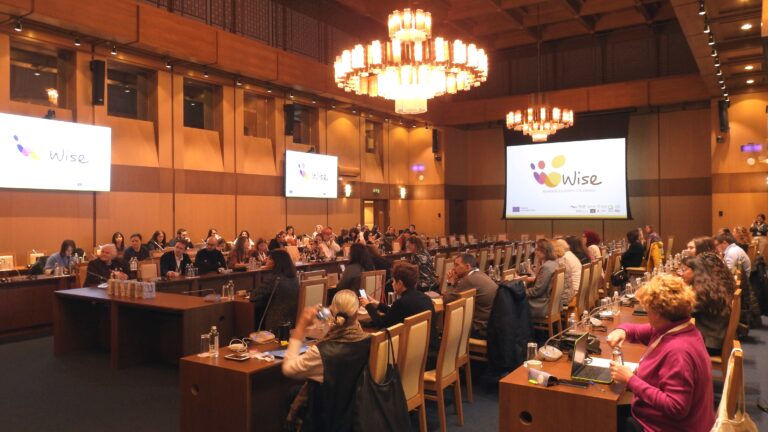
On Friday, 6 December 2024, almost 120 people from 16 countries met in Sofia, Bulgaria for the Pan-European launch of WISE — the first event that devoted an entire day exclusively to the high rates of energy vulnerability among women who hold sole responsibility for managing household resources, including energy.
Several participants noted the significance of the venue, as the Boyana Complex is a high-end government conference centre built during the Soviet Era, when men made decisions behind closed doors. Organising a conference in which vulnerable women and non-binary persons were able to speak freely — to an international audience in which women were the majority — represented a substantial societal shift for Bulgarian participants. That several media outlets, including the national broadcasters, covered the event and conducted interviews drew attention to an issue not previously discussed in Bulgaria.
WISE Partners note the excellent collaboration between INZEB (Greece) and Orion Grid to make the event such a success.
Morning sessions introduced the WISE project and particularities of energy vulnerability among women in each of the Partner countries:
[Elitsa Kapusheva, The Orion Grid] In Bulgaria, the National Collective consists of a diverse coalition of organisations, including environmental advocacy groups, NGOs with a sustainability focus, feminist and youth collectives, solidarity movements, organisations working with refugees, researchers, and urban planners. Generally, awareness of energy consumption patterns is high: people are conscious of how much energy they use and how seasonal changes affect their expenses. A key finding, however, is the limited awareness of energy poverty as a distinct concept. In turn, many affected individuals and groups focus primarily on immediate financial survival rather than long-term energy efficiency solutions. Gaps in awareness regarding available policies and support mechanisms mean that many people do not access opportunities for assistance. Language barriers further complicate access to support, as most available resources are in Bulgarian, making it difficult for Arabic and Ukrainian-speaking migrants to benefit from energy aid programmes. The Collective has outlined several recommendations, including the development of simple, multilingual educational materials, community-based energy awareness workshops, language translation efforts in outreach programmes, and leveraging existing local knowledge for policy advocacy.
[Paula Damaška, Green Energy Cooperative (ZEZ)] In Croatia, the National Collective includes NGOs, the Ombudsman’s office, the School of Public Health, a humanitarian aid network, energy cooperatives, and city representatives from the Social Welfare Office. The Croatian Collective has identified several key challenges and opportunities in addressing energy poverty. First, there is an urgent need to enhance social welfare and housing policies, ensuring that vulnerable populations have access to stable and energy-efficient living conditions. Targeted energy assistance measures should be expanded, particularly for single women and low-income households, to ensure they receive adequate support. Additionally, the Collective stresses the importance of promoting stakeholder collaboration, bringing together public authorities, civil society organisations, and energy providers to create more effective policies. Raising public awareness is also vital, as many individuals remain unaware of the programmes and assistance available to them. Finally, Croatia aims to leverage international best practices to improve their national strategy, learning from other European countries that have successfully tackled similar challenges.
[Marilyn Smith, The Energy Action Project (EnAct)] France has a relatively strong framework for addressing energy poverty, with several legal protections and subsidy schemes already in place. For instance, energy companies are legally prohibited from disconnecting customers between November and March, ensuring that vulnerable households are not left without heating during the winter months. Additionally, an ‘energy cheque’ is systematically delivered to low-income households to help them manage energy costs. However, a significant issue is that 25% of these cheques go unused, highlighting gaps in awareness and accessibility. Another major challenge is that while substantial subsidy programmes for energy efficiency renovations exist, they are not sufficiently targeted toward the most vulnerable groups, such as single women in precarious living situations. To address this, WISE efforts in France will focus on Aubervilliers, a suburb of Paris with high poverty rates, where 40% of the population lives at or below the poverty level, 60% live in rented accommodations, and 20% are single mothers. The Collective recognises that cultural and economic barriers prevent many women from fully participating in society in Aubervilliers, making it essential to develop interventions that address these intersecting challenges.
[Polina Gkioka, Wind of Renewal] In Greece, The collective brings together representatives from energy communities, the Municipality of Athens, migrant and refugee organisations, women’s rights activists, scientists, pensioners, political scientists, and academics. The Collective has observed that while Greece’s economy has stabilised, the energy crisis continues to place immense financial strain on households, particularly for the elderly and low-income groups. Elderly women are especially vulnerable because their higher heating and cooling needs due to health issues result in high energy bills, forcing them to cut spending on essentials such as food and medical care. Many low-income families, particularly migrants, rely on second-hand appliances, which consume excessive energy and drive up electricity costs. Poor housing quality is another major issue, as many buildings were constructed without proper insulation, leading to significant energy inefficiencies. Climate change is exacerbating the situation: prolonged high temperatures increase the demand for cooling, making it harder for vulnerable households to cope. Moreover, many people struggle to understand their electricity bills and contract options, leading to financial losses due to a lack of clear information and language barriers. The Collective stresses the importance of tailoring outreach efforts to different groups without stigmatising them, ensuring that energy poverty solutions are inclusive and accessible.
[Ana Stojilovska, ELTE Centre for Social Sciences] In Hungary, the National Collective includes civil society organisations, public institutions, academics, and students. A key focus of their work has been on defining energy poverty using both quantitative indicators and lived experiences. The Collective has identified large families with incomes below 60% of the median as being the most affected by energy and transport poverty. Hungary’s past utility cost reduction programme played a significant role in keeping energy costs low. Recent policy changes driven up prices, leading to a dramatic increase in energy poverty. The Collective has also highlighted the impact of gender and family policies, noting that government programmes often trap women in economic dependency, particularly single mothers who rely on state support. Additionally, institutions that provide shelter and support for women facing domestic violence have seen their energy costs increase, limiting their ability to operate effectively. The Hungarian Collective recommends developing comprehensive policies that address multiple aspects of poverty – including energy, transport, and seasonal issues – while ensuring women have full access to essential services. They emphasise the need for grassroots solutions, particularly those that empower vulnerable women through trusted local networks.
[Federica Ragazzo, RETE Assist] In Italy, the National Collective plays a key role in training Household Energy Advisors, professionals who receive specialised training on the social and technical aspects of energy poverty. These advisors help vulnerable households understand their energy consumption, access financial support, and implement energy-saving practices. The Collective has focused on scaling up these efforts to ensure that a greater number of households benefit from informed, energy-efficient decision-making. They are working to integrate energy advisors into existing social welfare programmes, ensuring that energy poverty is addressed holistically alongside housing, employment, and financial support.
[Marlies Hesselman, Faculty of Law, University of Groningen] In the Netherlands, a diverse National Collective includes elderly women, low-income women, female students, migrant women, female entrepreneurs working from home, civil society organizations, researchers, and policymakers. The Collective has identified that energy poverty is highly complex, as different women face distinct challenges depending on their life stage, housing situation, and economic circumstances. Many women lack control over their living situations and energy contracts, which prevents them from making cost-saving adjustments. Housing conditions also play a major role, as damp, mould, and cold indoor temperatures lead to significant health problems, particularly among the elderly. The Collective recommends documenting the lived experiences of women to better understand policy gaps, improving energy literacy, and increasing access to large-scale home renovations. They also emphasise the need for a life-cycle approach, recognising that women’s energy needs change throughout their lives, requiring targeted interventions at different stages.
Across geographies as diverse as the Western Balkans and Spain, and diving into gender aspects in areas ranging from energy access and rights to employment opportunities in the clean energy transition, this session drove home one key point: much more needs to be done to achieve truly just and inclusive energy systems. Featuring three dynamic women – Saska Petrova, Irene Gonzales-Pijuan and Lidija Živčič – it prompted introspection while delivering a call for action.
Saska Petrova, Principal Investigator on the Generate Project, explored the intersection of gender, energy poverty, and political structures, framing energy deprivation as a politically induced and gendered socio-ecological injustice. She emphasised that energy poverty is not just an issue of individual hardship but a consequence of systemic failures in economic and social networks that disproportionately affect certain populations. She introduced the concept of energy precarity, which highlights how institutional neglect and policy failures normalize energy deprivation, leaving vulnerable populations – especially single women –trapped in cycles of poverty.
Using the Western Balkans as a critical case study, Ms Petrova described it as an internal ‘island’ of non-EU member states with some of the highest energy poverty rates in Europe. Yet the region is paradoxically seen as a prime location for renewable energy development, leading to what she termed the “renewable energy El Dorado.” While large-scale renewable energy projects are promoted as solutions to energy security, many projects – such as the construction of thousands of small hydropower plants in protected areas – fail to address the social injustices linked to energy access. In some cases, they displace vulnerable communities.
Ms. Petrova also spoke about the gendered nature of energy-related violence and exclusion, introducing insights from feminist energy geographies and feminist political ecology, which show that energy policies often reinforce traditional gender roles and deepen inequalities. She called for a shift towards an ecofeminist energy framework, which challenges binary thinking in energy policy –such as private vs. public, collective vs. individual, and vulnerable vs. resilient – and instead seeks to integrate gender-sensitive approaches that acknowledge the lived experiences of women in energy-deprived communities.
Irene Gonzales-Pijuan provided a grassroots perspective on combating energy poverty, emphasising the power of collective action and mutual support in advocating policy change. She framed energy poverty as a human rights issue, deeply tied to gender, economic precarity, and institutional neglect.
She began by tracing the history of energy poverty activism in Spain, highlighting key milestones that have transformed the policy landscape. In 2013, Spain recorded over 1 million supply disconnections, disproportionately affecting low-income households, many of which were led by women. In response, affected communities in Catalonia began to self-organise, leading to the formation of the L’Aliança contra la Pobresa Energètica (APE) in 2014. Through collective mobilisation and legal advocacy, the movement successfully secured a legislative ban on disconnections for vulnerable people in Catalonia in 2015, which has since prevented more than 200,000 supply disconnections.
The APE’s work is built on three key pillars: mutual support, advocacy, and direct action. The organisation has hosted over 200 collective advice sessions, helping women and low-income families navigate the complexities of energy bills, access financial aid, and understand their rights. The APE also played a central role in negotiating the cancellation of energy and water debts, including a landmark case in which debt to Endesa (one of the main suppliers) was canceled for 41,000 families. In turn, the APE has led legal challenges against aggressive debt collection practices, securing a judicial victory against Endesa’s debt collectors and extending the ban on disconnections at a national level.
Beyond legal victories, Ms. Gonzales-Pijuan emphasised the psychological impact of energy poverty, particularly on women. Many women experience shame, guilt, and isolation due to their inability to pay energy bills. The APE has worked to reframe the narrative around energy poverty, advocating for a collective responsibility approach rather than individual blame. Through community assemblies, women share their experiences, build social solidarity, and empower themselves through knowledge and activism. She concluded by underscoring the importance of feminist organising in energy justice movements, stating that energy poverty must be addressed through both legal frameworks and social transformation.
Lidija Živčič examined how the environmental aspects of the energy transition intersect with gender disparities, questioning whether the current push for decarbonisation is truly gender-inclusive. She argued that energy transition policies often overlook the specific needs of women, particularly single women and low-income households, making them more vulnerable to energy poverty.
Ms. Živčič outlined four key dimensions of gendered energy poverty: physiological, economic, health, and social/cultural. Women, she noted, often have lower incomes, higher caregiving responsibilities, and limited decision-making power in household energy management. These factors exacerbate their vulnerability to energy insecurity, particularly in times of economic crisis or rising energy prices.
One major issue Ms. Živčič highlighted was the gendered impact of housing and homeownership in the energy transition. Men are more likely to be homeowners, whereas women are disproportionately tenants, making them less able to benefit from energy efficiency improvements. As a result, renovation projects that raise the value of properties often increase rental prices, pushing low-income women into even more precarious living conditions. She pointed to the LIFE Renoverty Project, which examines how renovation policies can be made more inclusive.
Ms. Živčič then discussed the employment implications of the green transition, noting that job creation in the energy sector is largely concentrated in male-dominated fields, such as construction, building renovation, and renewable energy infrastructure. This limits women’s access to stable employment in the growing green economy. She then introduced the Empowering Underrepresented Women in the Energy Sector (EUWES) project, which seeks to identify barriers to women’s participation in the energy workforce and advocate for gender-inclusive policies.
Another critical issue Ms. Živčič raised was women’s underrepresentation in energy policy-making and governance. Energy transition policies are often formulated by ministries responsible for economic affairs, infrastructure, and spatial planning – fields where men dominate decision-making roles. This results in policies that fail to account for gender-specific vulnerabilities. Even within energy communities, where decentralised renewable energy projects are developed, women are significantly underrepresented as members and decision-makers, limiting their influence in shaping more equitable energy policies.
To address these challenges, Ms. Živčič emphasised the need for gender-responsive policies that actively promote women’s participation in energy governance, employment, and community initiatives. She highlighted the Gender4Power initiative, which aims to increase women’s involvement in energy transition leadership and ensure that policies prioritize social equity. She concluded with a call for action, urging policymakers, researchers, and activists to integrate gender considerations into all aspects of the energy transition. Without intentional efforts to bridge the gender gap in policy, employment, and community participation, the energy transition risks deepening existing inequalities rather than solving them.
To create opportunity for small-group interaction among participants, WISE arranged seven Workshop Sessions, each seeking to dive more deeply into how familiar challenges are not yet addressing the specific needs of women in energy vulnerability. Short summaries follow.
This workshop explored strategies to identify and engage with single women facing energy poverty. The session began with a roundtable discussion where participants shared their professional and personal experiences, including challenges such as energy precarity due to illness, financial instability post-divorce, and mistrust of social services.
Key discussions revolved around identifying trusted local influencers to serve as contact points for reaching vulnerable women. It was widely agreed that community mapping could identify key figures such as local social workers, teachers, and religious leaders who can help build trust. Additionally, empathy training for these key figures was suggested to better recognise stress indicators and energy needs. The importance of secure data collection and privacy protections was also emphasised to ensure women feel safe seeking help.
Innovative engagement strategies were proposed, such as informal café meetings to create a non-intimidating environment where women can discuss their energy concerns. Digital solutions, such as online forums (e.g., BG Mama in Bulgaria), were also identified as effective means for anonymous engagement and peer-to-peer support. The workshop concluded that a combination of localised community engagement and digital platforms could significantly enhance outreach and trust-building.
This session focused on addressing the gap in energy literacy among single women, particularly those who have had limited prior responsibility for household energy management. Participants highlighted how traditional energy knowledge is often passed informally within families, and how cultural norms often position men as the primary household energy decision-makers.
To address this, an “empathy mapping” exercise was conducted to better understand the perspectives of single women regarding energy use. The findings led to a structured approach to knowledge dissemination:
The workshop concluded with a recommendation to develop short video tutorials and local workshops focused on empowering women with the necessary knowledge to take control of their household energy use.
This session addressed the challenges and opportunities in improving home energy efficiency for single women. The discussion highlighted that many energy-poor households face outdated infrastructure, poor insulation, and inefficient heating systems, which exacerbate their financial burden.
Best practices from different countries were shared. The Netherlands and Hungary, for instance, have schemes that provide low-interest loans and small grants (ranging from €100 to €4,000) for energy-efficient home upgrades. Additionally, the importance of solidarity-based initiatives, such as community-driven energy efficiency projects and volunteer-led home repairs, was emphasized.
One major barrier identified was the lack of experienced technicians to provide guidance on energy efficiency improvements. Participants proposed establishing local training workshops to equip women with basic maintenance skills, such as sealing leaks, installing insulation, and using energy-efficient heating solutions. Another key concern was the risk of installing inappropriate technology, as demonstrated by a Hungarian programme where households were given expensive heating systems they could not afford to run. The workshop concluded with a call for more community-driven initiatives and increased access to tailored financial assistance programs.
This workshop examined the financial and psychological pressures faced by single women in managing household energy costs. Participants discussed how single households often face the same energy costs as those with two adults but lack shared financial support. This issue is compounded by ‘time poverty’, as single women often juggle multiple responsibilities with limited time for energy-saving efforts.
Discussions focused on behavioral changes that could be introduced without creating additional stress. Recommendations included smart energy use strategies, such as shifting high-energy activities to off-peak hours and reducing phantom energy consumption. A recurring theme was the importance of making energy-saving efforts family-oriented, so children and teenagers understand their role in efficient energy use.
Additionally, creating safe spaces where women can ask for help and learn from others was highlighted as crucial. One-stop shops providing energy advice in familiar community spaces, such as churches, schools, or women’s centers, were proposed. The session concluded with an emphasis on advocacy for clearer and simplified energy bills, so women can make informed decisions without technical complexity.
The discussion in this workshop revolved around the specific challenges faced by migrant and marginalised women in accessing reliable energy. Participants noted that these communities often live in deprived areas with inadequate infrastructure, making them particularly vulnerable to energy poverty.
Language barriers were identified as a significant obstacle to understanding energy bills and navigating financial assistance programmes. To address this, multilingual resources and cultural mediators were recommended. Furthermore, the precarious legal status of some migrants was discussed as a reason for hesitancy in seeking help, necessitating anonymous and non-governmental outreach solutions.
Participants stressed that while community energy initiatives could offer a long-term solution, these programs often fail to reach the most marginalized due to restrictive eligibility criteria. Therefore, advocacy efforts should push for more inclusive energy policies and targeted financial interventions.
This session emphasised the role of language and framing in effective advocacy. While the term ‘energy poverty’ is widely used, it carries negative connotations, and alternative phrases such as ‘energy precarity’ may be more empowering. The importance of tailoring messaging to different audiences—using data for policymakers and relatable narratives for affected communities—was underscored.
Successful advocacy campaigns were examined, such as the Alliance Against Energy Poverty in Spain, which successfully pushed for a legislative ban on energy disconnections. Participants also discussed the French initiative ‘Stop Energy Exclusion’, which has mobilised a broad coalition to fund home renovations for low-income households.
This workshop explored policy gaps affecting single women in energy poverty. Discussions highlighted that while energy poverty is acknowledged at the legislative level, specific policies targeting single women remain absent. Participants noted the lack of gender-disaggregated data in energy-related surveys, making it difficult to craft policies that reflect the lived realities of single women.
The workshop emphasised the importance of simplifying energy bills to make them more user-friendly, increasing financial and digital literacy programmes, and ensuring that subsidies for energy-efficient upgrades are accessible to renters and low-income homeowners. Participants also discussed the challenges single women face in securing bank loans for energy renovations due to low credit scores. It was suggested that alternative financing mechanisms, such as microloans or community-based grants, be explored.
Further recommendations included targeted training for energy advisors to assist women in navigating bureaucratic processes and advocating for policies that embed a rights-based approach to energy access. The session concluded with a call for greater collaboration between government agencies, financial institutions, and community organisations to create holistic and sustainable solutions tailored to the unique challenges faced by single women.
This session brought together distinguished speakers – Marlies Hesselman, Faculty of Law, University of Groningen; Rosalyn Park, Women’s Human Rights Program; and Jacob Udo-Udo Jacob, American University in Bulgaria – to examine the intersection of energy policy and human rights, focusing on the need for a fair and inclusive transition. Their insights guided discussions on how human rights law can be applied to energy policies to ensure equitable access, prevent discrimination, and support those most affected by energy-related challenges. As European Union directives push for advancements in energy markets, building performance, and efficiency, it is crucial to address systemic injustices that disproportionately affect vulnerable groups, particularly single women. The session was moderated by Milena Stateva, The Orion Grid.
Rosalyn Parks started with a powerful speech on the importance of human rights for social justice and energy justice. Human rights are concerned with human dignity and well-being. She highlighted that while a right to energy may not be widely recognised in international legal instruments, several existing human rights law instruments, such as the UN Women’s Rights Convention or the International Covenant on Economic Social and Cultural Rights, can be used to protect the right to energy. These include rights such as the right to an adequate standard of living, or the right to health. Human rights are important legal standards, which governments are obliged to implement. The human rights law framework can be used to demand action from states, also in the area of better access to energy for a life with human dignity, well-being, health and adequate living standards.
Marlies Hesselman noted that in addition to relevant international legal frameworks for human rights protection, a considerable body of European and national law recognizes the right to energy in some way. For example, the EU Pillar on Social Rights includes the ‘right to essential services of good quality’ including energy services, and support for those in need since 2017. Similarly, in national jurisdictions all around the world, courts have begun to recognise the right to energy in court cases, for example protecting households against energy disconnections or unaffordable tariff increases. This means that legal recognition of the concept of energy as a human right has been growing in legal practice. This also translates into EU energy law, which protects households all across Europe. For example, the notion of a right to energy is visible in new EU Electricity Market Directive 2024/1711, which since recently legally obliges all EU Member States to put in place protective measures that fully protect vulnerable households against energy disconnections due to inability to pay. This also benefits women, who may be disproportionally affected. In Europe, these rights have been hard fought for by EU civil society, including the EU Right to Energy Coalition. This shows the importance of strong civil society movements for making human rights a reality.
Jacob Udo-Udo Jacob spoke about the important relationship between human rights and democracy. Democracy cannot function without the protection of human rights, which are an important basic value. Human rights protection must be vied for and cannot be readily assumed. It is also vital to remember that, even in democracies, human rights may be threatened.
Of particular relevance to local participants, Mr. Udo-Udo Jacob also spoke about ‘communist nostalgia’, a narrative that reflects a longing for the past, not necessarily for communism itself but for a time when homes were warm and life felt more secure. He emphasized that for democracy to succeed, it must be seen as more than just political freedoms, civil liberties, or media freedom. Democracy should provide tangible benefits, including access to energy, economic opportunities, and basic necessities. When people struggle with energy poverty and economic hardships, they lose faith in democracy.
Finally, Mr. Udo-Udo Jacob highlighted the importance of policy work in addressing energy poverty, framing it as a form of ‘voice poverty.’ He urged people not to rely solely on policymakers or political leaders but to recognise their own role in advocating for policies that improve daily life. Mr. Udo-Udo Jacob emphasised that advocacy is different from lobbying and that democracy, as well as advocacy, must be actively taught and learned. Civil society leaders, business leaders, and ordinary people must be equipped with advocacy skills to push for necessary changes.



The Orion Grid amplifies change by bringing together the energy of the bearers of the democratic impulse. It works through educational, consultative, artistic, public and other interventions.